
Spiral jack is a commonly used lifting tool in large construction sites, bridge construction and other large-scale work environments, as well as in small work environments such as mechanical equipment maintenance and vehicle maintenance. It has powerful functions, but at the same time, it also has to withstand heavy pressure, especially in the short moment when the heavy object needs to be temporarily converted to load-bearing function after being lifted to a specified height, which tests the bearing capacity of the jack. Whether the jack can hold up at this time depends on the locking effect of its internal threads.
The types of threads available in threaded devices include rectangular, trapezoidal, and serrated. However, trapezoidal threads are commonly used in jacks, and some people also say rectangular threads. In fact, this statement is from the past because serrated threads are used for single-sided force application, while rectangular threads are rarely used due to poor processability and low strength. They were gradually replaced by trapezoidal threads.
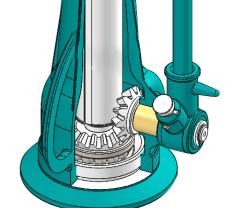
The trapezoidal thread has an isosceles trapezoid tooth shape with a tooth angle of α=30. The internal and external threads of the trapezoidal thread are tightly adhered on a conical surface and are not easily loosened. Rectangular thread roots have low strength, while serrated thread teeth have an unequal trapezoidal shape, resulting in high processing costs. From a practical perspective, trapezoidal threads are chosen.
Ordinary screw jacks rely on the self-locking effect of threads to support heavy objects, keeping them in a standing state, while the threads of self lowering jacks do not have self-locking effect and need to rely on internal brakes to control the lifting and lowering of heavy objects.
Tag:
2026-04-01
2026-03-25
2026-03-25
2026-03-25
2026-03-18
2026-03-18
2026-03-18
2026-03-11
2026-03-11
2026-03-11